
21 Sep 2026 The Debt Can’t Wait: Budget Committee Leaders Discuss Fiscal Solutions in Economics and Finance
Ahead of the House Budget Committee field hearing, “America’s Fiscal Future,” Bipartisan Policy Center Action submitted a letter for the record to Chair Jodey Arrington (R-TX) and Ranking Member Brendan Boyle (D-PA). With the national debt recently surpassing the bleak milestone of $40 trillion, the urgency for policymakers to reverse course and put the U.S. on a more sustainable fiscal path grows each day.
An Unsustainable Fiscal Trajectory
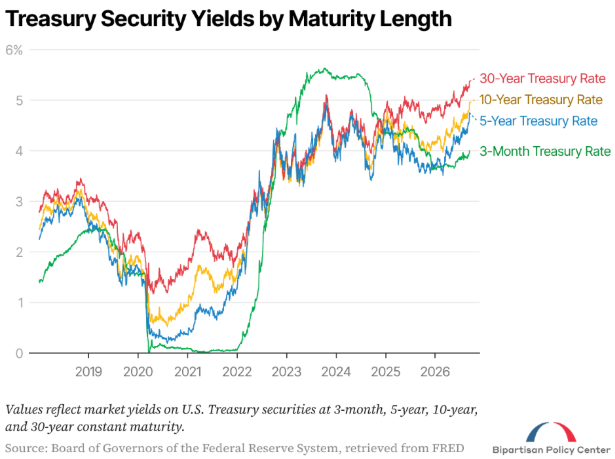
Because of the government’s enormous borrowing needs, Treasury yields are rising despite intervention from the Treasury Department. The 30-year yield breached 5.3% in August, and the 10-year Treasury recently hit 5%, its highest mark since the Great Recession.
This is not an abstract accounting problem; the debt is increasing the cost of living for American families and limiting our competitiveness. Rising Treasury yields are driving up borrowing costs, making it harder to afford mortgages, car loans, and student loans. They also crowd out private sector investments, price out small business, and raise energy costs.
Bending the Curve
To reverse course and put the country on a sustainable fiscal path, we first need to stop making the problem worse. Currently, the budget deficit is projected to exceed 6% of GDP over the next decade, far outpacing reasonable expectations of economic growth. Reducing that deficit to 3% of GDP would stabilize the debt as a share of GDP and relieve cost pressure.
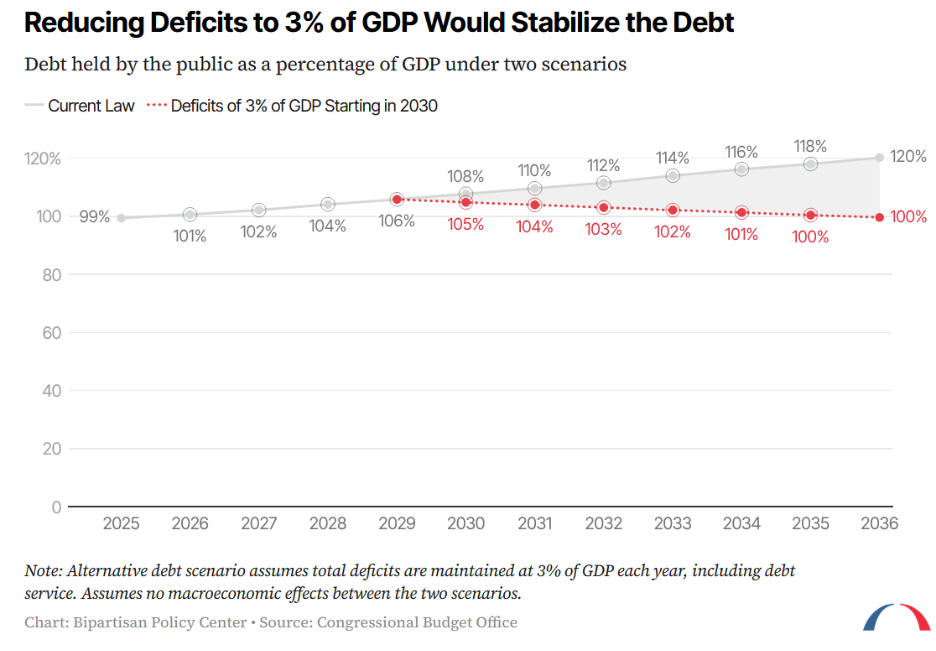
Bipartisan resolutions in both chambers—S.Res.654 and H.Res.981—would establish a goal of reducing the deficit to 3% of GDP or lower by 2030. BPC Action strongly urges Congress to adopt these resolutions and work toward fulfilling their targets.
Roadmap to Progress: A Fiscal Commission
To achieve even a 3% deficit target, Congress will need both parties at the table considering all possible options for spending and revenue adjustments. That is why BPC Action endorses the Fiscal Commission Act, led by Reps. Bill Huizenga (R-MI) and Scott Peters (D-CA), which would create a bipartisan, bicameral fiscal commission composed of members from both parties and nonvoting outside experts to produce concrete policy solutions and legislative language to enact them.
We believe the Fiscal Commission is structured to give its proposals the best possible chance of success by requiring buy-in from leaders in both parties and mandating public hearings and reports to ensure full transparency and a broad range of stakeholder input. It also has strong support in Congress, with 53 bipartisan cosponsors across both chambers.
Read the full letter here.

